
Fun Facts About Animals
The animal kingdom keeps producing things no committee would have approved. Here are forty facts about the creatures we share the planet with: the sleepers, the swimmers, the ones with too many hearts.
An octopus has three hearts: two pump blood through the gills and one drives it around the rest of the body. That third heart stops beating when the animal swims, which is part of why octopuses would rather crawl.
Source: Smithsonian Ocean
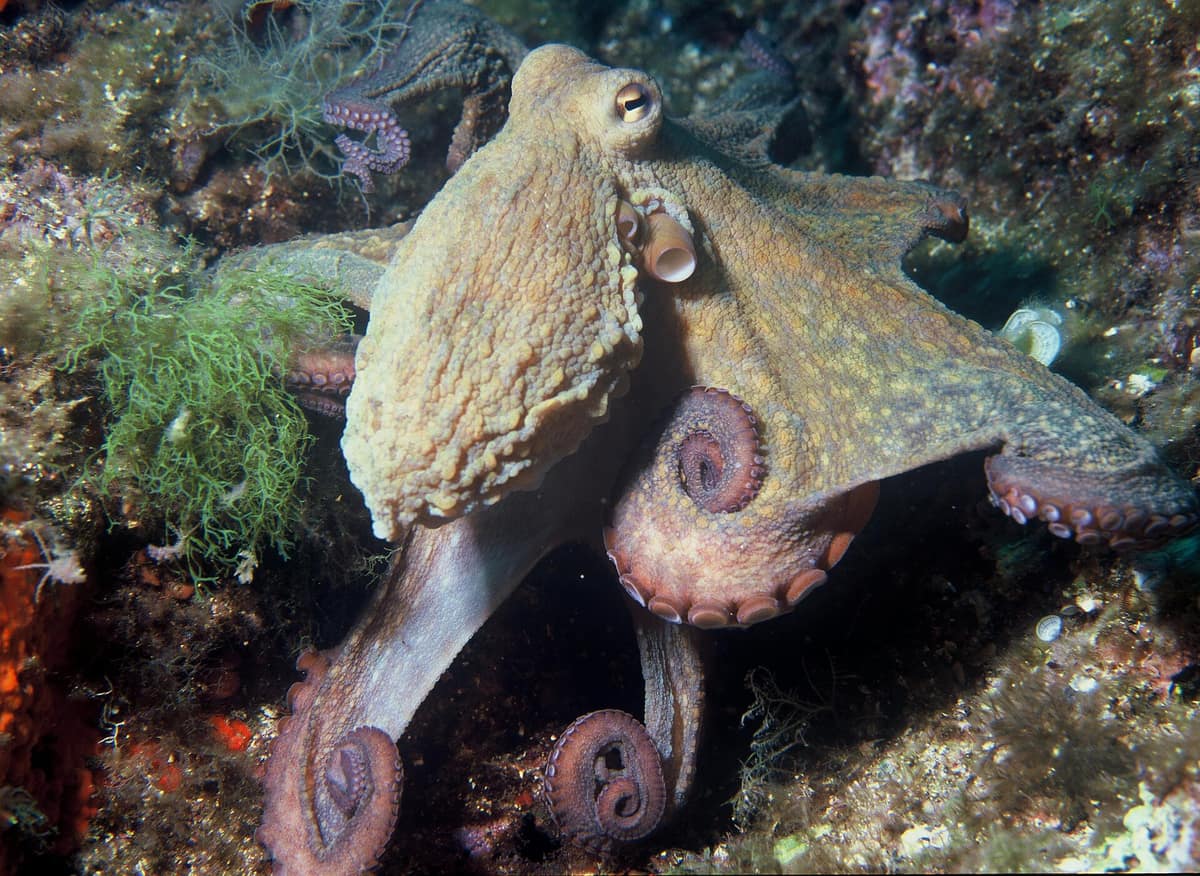
A common octopus, Octopus vulgaris. Two of its three hearts serve the gills alone. Photo: Albert Kok at Dutch Wikipedia The sperm whale has the largest brain of any animal that has ever been measured, weighing in at around 7.8 kilograms - roughly five times the mass of a human brain.
Source: Smithsonian Ocean
The Arctic tern makes the longest migration known in the animal kingdom, tracked at over 70,000 kilometres a year as it commutes between Arctic breeding grounds and Antarctic waters. It effectively lives in perpetual summer.
Source: British Antarctic Survey
The wood frog spends winter frozen solid. Its heart stops, its breathing stops, and up to two-thirds of the water in its body turns to ice, with glucose acting as a cryoprotectant until it thaws in spring.
Source: US National Park Service
The saltwater crocodile holds the highest bite force ever directly measured in a living animal: about 16,460 newtons, or roughly 3,700 pounds of force.
Source: Erickson et al., PLOS ONE (2012)
Honeybees tell each other where food is by dancing. The angle of the bee's waggle run relative to vertical encodes the direction of the flowers relative to the sun, and the duration encodes the distance - a discovery that earned Karl von Frisch a share of the 1973 Nobel Prize.
Source: Nobel Prize in Physiology or Medicine, 1973
The Greenland shark is the longest-lived vertebrate known. Radiocarbon dating of eye lens tissue put one individual at roughly 392 years old, and the species does not appear to reach sexual maturity until around 150.
Source: Nielsen et al., Science (2016)
Mantis shrimp eyes carry up to 16 types of photoreceptor, against the three humans get by with. Rather than fine colour discrimination, the arrangement appears to let them recognise wavelengths quickly without much processing.
Source: Thoen et al., Science (2014)
The naked mole-rat lives like an insect. Colonies of up to 300 are run by a single breeding queen, with the rest serving as non-reproductive workers - a social structure otherwise almost unknown in mammals.
Source: Smithsonian National Zoo
Male emperor penguins incubate a single egg on their feet through the Antarctic winter, balancing it under a fold of skin for about 65 days without eating anything at all.
Source: British Antarctic Survey
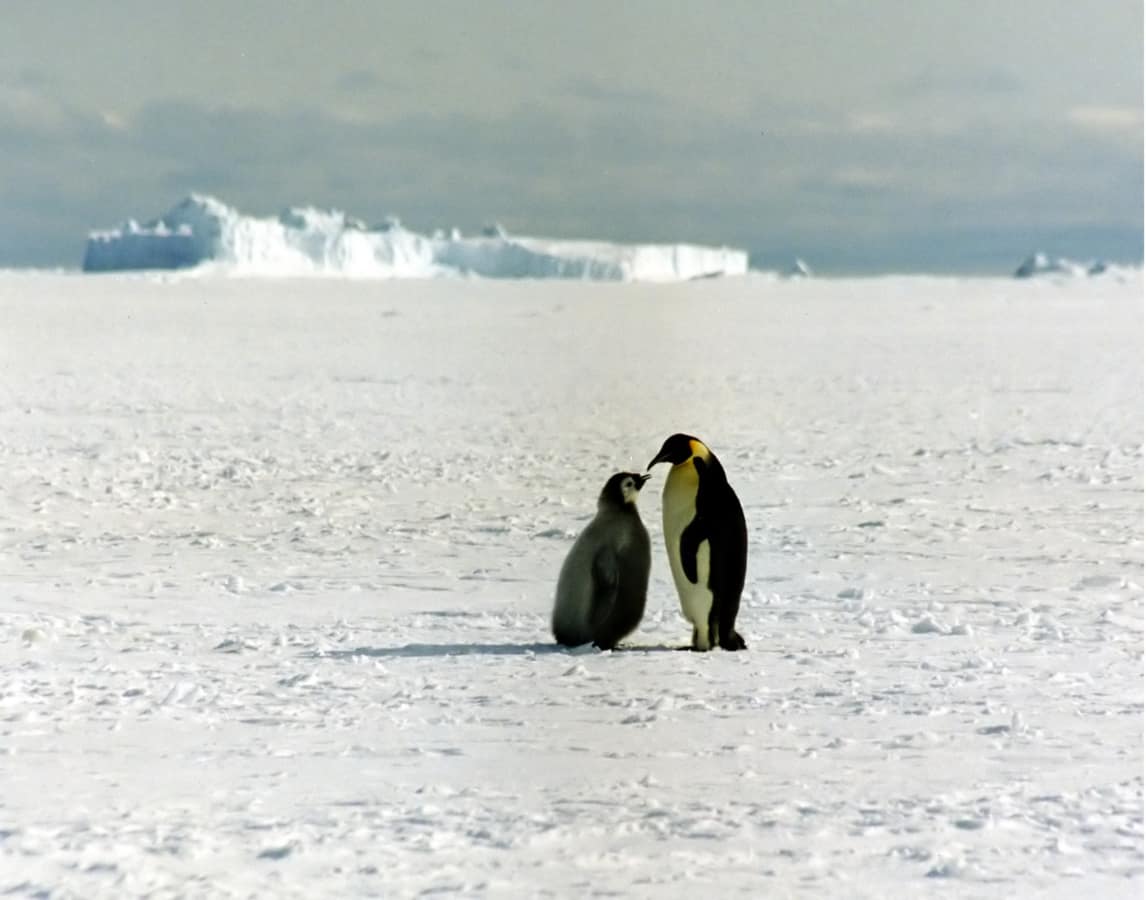
An emperor penguin and chick. The male holds the egg on his feet for about 65 days without eating. Photo: Brocken Inaglory The axolotl never grows up. It keeps its feathery external gills and stays aquatic for life, and it can regrow amputated limbs, tail, and portions of heart and brain tissue.
Source: Smithsonian National Zoo
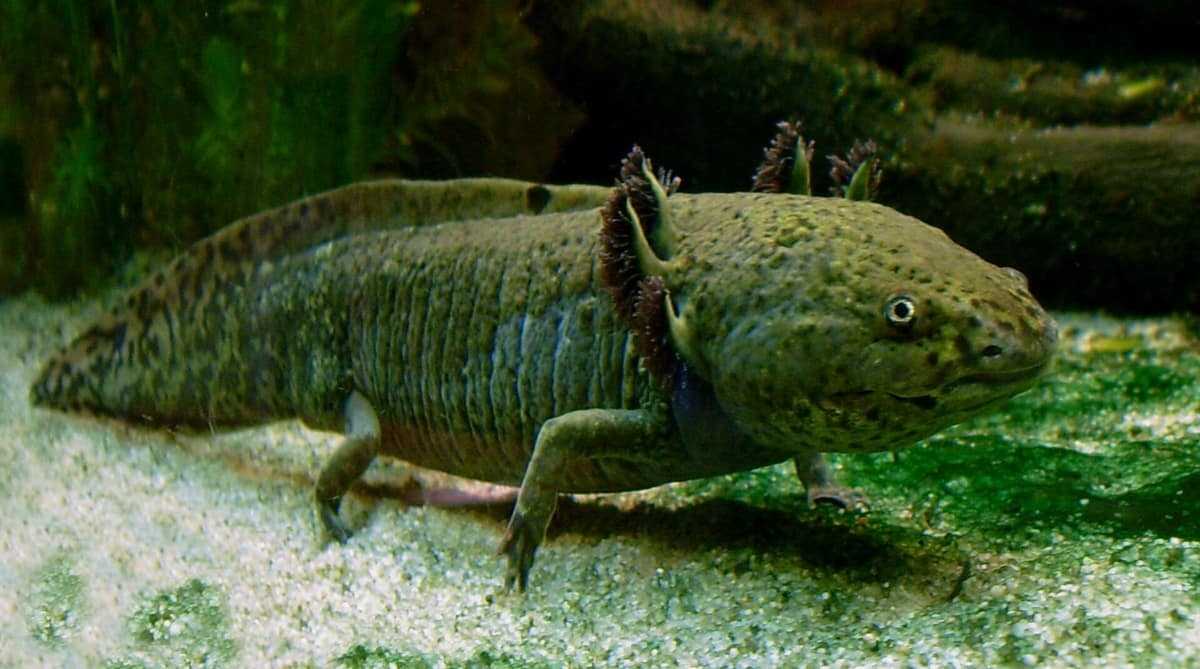
The axolotl keeps its larval gills for life, and regrows limbs it loses. Photo: LoKiLeCh The tuatara of New Zealand is the last survivor of an entire reptile order that otherwise died out over 60 million years ago. Young tuatara also have a light-sensitive parietal eye on top of the head, complete with a rudimentary lens and retina.
Source: Te Papa Tongarewa
The bombardier beetle defends itself by mixing hydrogen peroxide and hydroquinone in an internal chamber and firing the result at attackers. The spray leaves the abdomen at around 100 degrees Celsius, in rapid pulses.
Source: Aneshansley and Eisner, Science (1969)
The heaviest bony fish on record is an ocean sunfish, a flattened disc of an animal weighing over 2,000 kilograms. It spends much of its time basking sideways at the surface, which is how it got the name.
Source: Guinness World Records
The jellyfish Turritopsis dohrnii can reverse its life cycle. Under stress, an adult medusa settles down and reverts to the polyp stage it grew from, then starts over - biological ageing running backwards.
Source: American Museum of Natural History
Sea otters have no insulating blubber, so they rely entirely on fur, packed at up to a million hairs per square inch. It is the densest coat of any animal, and it has to be groomed constantly to keep working.
Source: Monterey Bay Aquarium
The peregrine falcon is the fastest animal on Earth, exceeding 320 kilometres per hour in a hunting stoop. Baffles in its nostrils are thought to keep the airflow manageable at that speed.
Source: Cornell Lab of Ornithology
Cuttlefish produce some of the most elaborate colour displays in the ocean while being, as far as their single visual pigment allows, colourblind. They can, however, detect the polarisation of light, which most vertebrates cannot.
Source: Marshall and Messenger, Nature (1996)
Female Komodo dragons can reproduce without a male. Two captive females in British zoos produced viable eggs through parthenogenesis in 2006, and genetic testing confirmed no paternal contribution.
Source: Watts et al., Nature (2006)
Periodical cicadas of the genus Magicicada spend either 13 or 17 years underground before emerging in vast synchronised broods. Both intervals are prime numbers, which makes it awkward for any predator trying to sync its own cycle to theirs.
Source: US Forest Service
Electric eels are not eels but knifefish, and one species, Electrophorus voltai, has been recorded discharging up to 860 volts - the strongest electric discharge measured in any animal.
Source: de Santana et al., Nature Communications (2019)
Horseshoe crab blood is blue, thanks to copper-based hemocyanin, and it clots on contact with bacterial endotoxin. That reaction became the standard laboratory test for contamination in injectable drugs and implants.
Source: US Food and Drug Administration
The star-nosed mole is the fastest known forager among mammals. The 22 fleshy tentacles on its snout let it identify an item of prey and decide whether to eat it in as little as eight milliseconds.
Source: Catania and Remple, Nature (2005)
Bar-headed geese cross the Himalayas on migration, tracked at altitudes above 7,000 metres where oxygen is roughly half its sea-level concentration. Their haemoglobin binds oxygen unusually tightly to make it work.
Source: Hawkes et al., PNAS (2011)
The Surinam toad carries its eggs embedded in the skin of its own back. The young develop in individual pockets and eventually push out as fully formed toadlets, skipping the free-swimming tadpole stage entirely.
Source: Smithsonian National Zoo
Leafcutter ants do not eat the leaves they carry. They use the cuttings as compost for underground fungus gardens, and the fungus is the actual crop - an agricultural arrangement several million years older than human farming.
Source: Smithsonian National Museum of Natural History
Antarctic icefish of the family Channichthyidae are the only known vertebrates with no haemoglobin as adults. Their blood runs clear, and they survive on oxygen dissolved directly in plasma in very cold, oxygen-rich water.
Source: British Antarctic Survey
The narwhal's tusk is a tooth - a single canine that spirals through the upper lip and can reach three metres. It is riddled with nerve endings, which suggests it works partly as a sensory organ.
Source: Smithsonian National Museum of Natural History
A barn owl's ear openings sit at different heights on its skull. The asymmetry gives it vertical as well as horizontal sound localisation, accurate enough to catch a mouse under snow in complete darkness.
Source: Cornell Lab of Ornithology
The colossal squid has the largest eyes of any known animal, measured at around 27 centimetres across in one specimen. The working theory is that they are tuned to spot the faint bioluminescent glow stirred up by an approaching sperm whale.
Source: Te Papa Tongarewa
The pistol shrimp snaps one oversized claw fast enough to create a cavitation bubble. The bubble's collapse stuns prey, produces a flash of light, and generates a crack loud enough to interfere with sonar.
Source: Versluis et al., Science (2000)
Small chameleons have the most powerful tongues of any reptile relative to size. The tongue of Rhampholeon spinosus accelerates at up to 264 times the force of gravity, driven by stored elastic energy rather than muscle contraction alone.
Source: Anderson, Scientific Reports (2016)
Dung beetles rolling a ball at night keep a straight line by navigating on the Milky Way. Fitted with tiny cardboard caps that blocked their view of the sky, they lost the plot and wandered in circles.
Source: Dacke et al., Current Biology (2013)
Common vampire bats regurgitate blood meals to share with roost-mates that failed to feed, and they preferentially help bats that have helped them before. A vampire bat can starve after roughly two nights without a meal, which makes the arrangement worth maintaining.
Source: Wilkinson, Nature (1984)
Flamingos are born grey. The pink comes from carotenoid pigments in the algae and brine shrimp they eat, and a flamingo on the wrong diet fades back to white.
Source: Smithsonian National Zoo
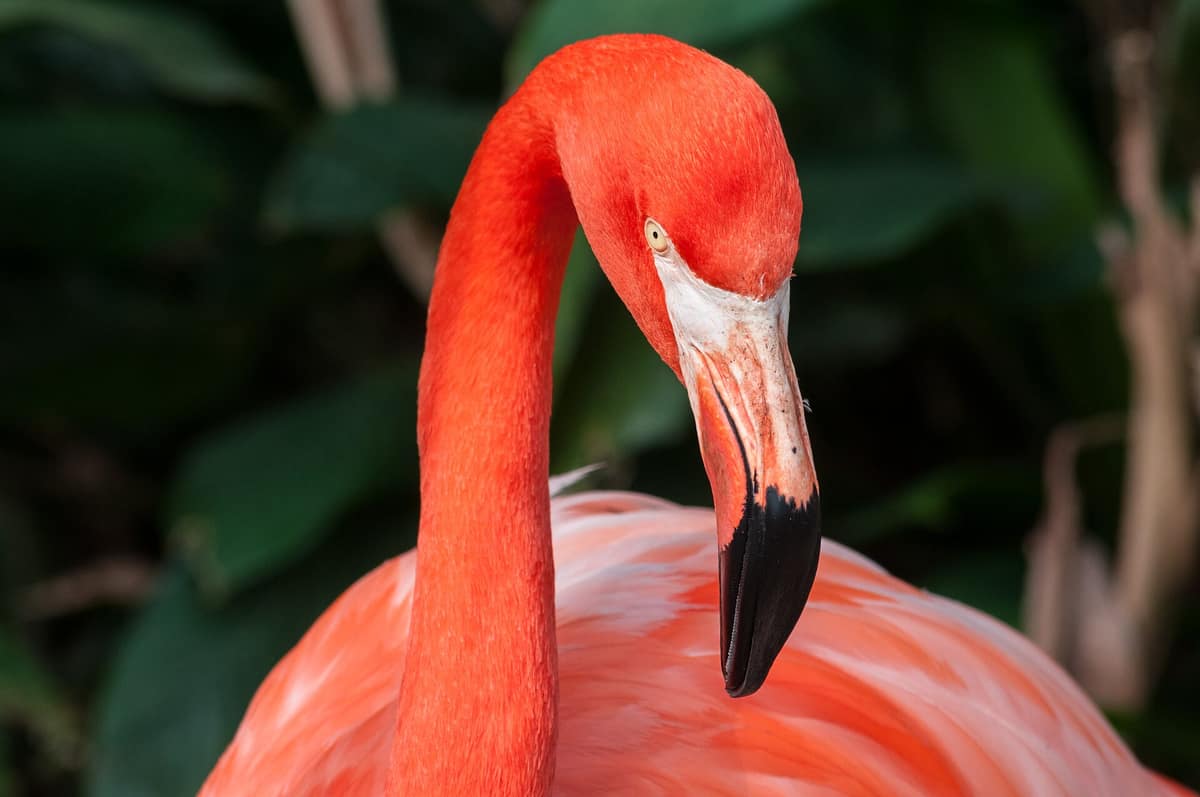
Flamingo pink is borrowed. It comes from carotenoids in algae and brine shrimp. Photo: Wilfredor In several deep-sea anglerfish species the tiny male bites onto a female and never lets go. His tissues fuse with hers, his organs degenerate, and he persists as little more than an attached supply of sperm.
Source: Monterey Bay Aquarium Research Institute
A sea star eats by pushing its stomach out through its mouth and digesting prey externally. Once the meal is broken down, the stomach is drawn back inside.
Source: NOAA
Young of the Kenyan caecilian Boulengerula taitana feed by peeling and eating the outer layer of their mother's skin, which she grows thick and nutrient-rich for the purpose. She regenerates it every few days.
Source: Kupfer et al., Nature (2006)
The platypus hunts with its eyes, ears and nostrils shut. Thousands of electroreceptors in its bill detect the electrical fields of muscle activity in prey buried in the riverbed.
Source: Australian Museum
The turkey vulture finds carrion by smell, which is unusual among birds and exceptional in its precision - it can locate a carcass hidden under forest canopy. Its olfactory bulb is among the largest, relative to brain size, of any bird.
Source: Cornell Lab of Ornithology