
Fun Facts About Space
Space is mostly nothing, and the something is very strange indeed. Forty facts about the planets, the stars and the distances that make the numbers stop meaning anything.
The Sun holds about 99.8 percent of all the mass in the solar system. Every planet, moon, asteroid and comet put together is essentially rounding error.
Source: NASA
Mercury turns exactly three times on its axis for every two trips around the Sun. The arithmetic of that lock means a single solar day there lasts about 176 Earth days, twice the length of Mercury's 88-day year.
Source: NASA
Venus spins backwards compared with most planets, and it spins slowly: one rotation takes 243 Earth days while one orbit takes only 225. The planet's day outlasts its year.
Source: NASA
Earth is the only planet in the solar system whose English name does not come from Greek or Roman mythology. It derives from old Germanic and Anglo-Saxon words simply meaning ground.
Olympus Mons on Mars rises roughly 22 kilometres above the surrounding plains, about two and a half times the height of Everest above sea level. Its base would comfortably cover the state of Arizona.
Source: NASA
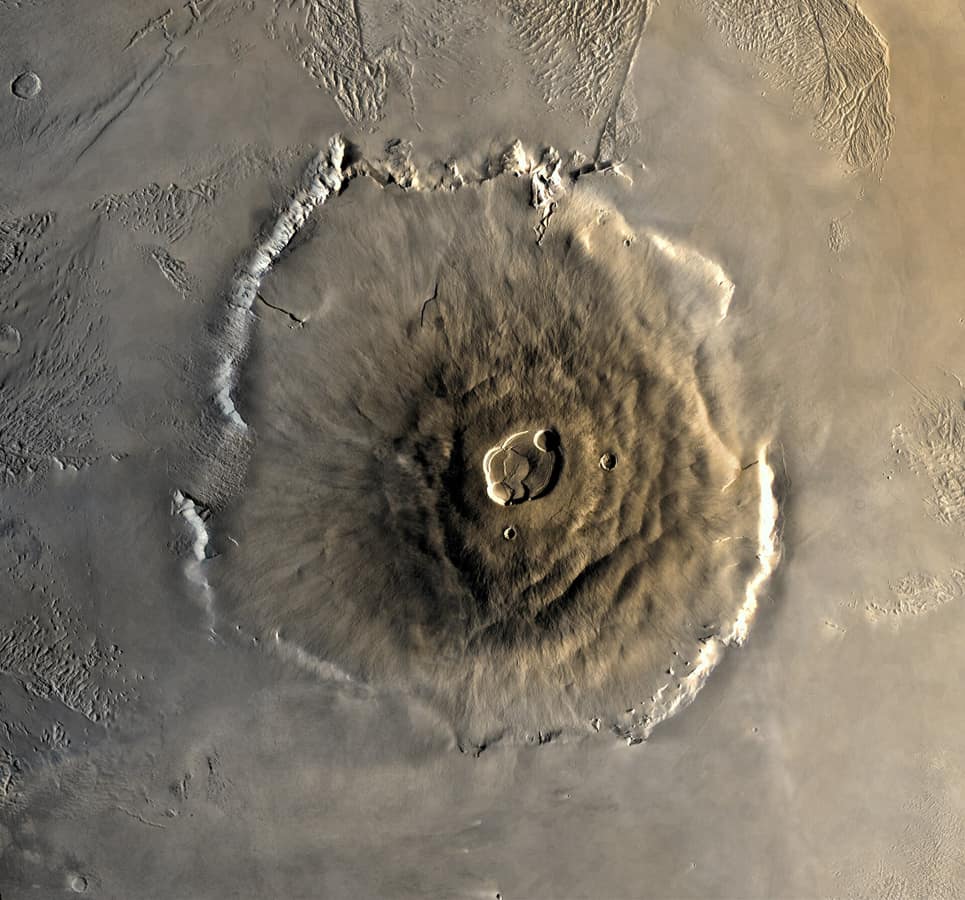
Olympus Mons on Mars, roughly two and a half times the height of Everest. Photo: Image by NASA, modifications by Seddon Jupiter is more than twice as massive as every other planet in the solar system combined. It is also the fastest spinner, completing a rotation in under ten hours.
Source: NASA
Saturn has an average density of about 0.69 grams per cubic centimetre, lower than that of water. It is the only planet in the solar system that would, in principle, float in a sufficiently large bath.
Source: NASA
Uranus is tipped over by about 98 degrees, so it rolls around its orbit rather than spinning upright. Each pole gets roughly 42 years of continuous sunlight followed by 42 years of darkness.
Source: NASA
Neptune was found with mathematics before it was found with a telescope. Urbain Le Verrier calculated where an unseen planet must be from irregularities in Uranus's orbit, and Johann Galle spotted it within one degree of the prediction on 23 September 1846.
Source: NASA
Pluto takes about 248 Earth years to circle the Sun. Discovered in 1930, it has not yet completed a single orbit since anyone knew it existed.
Source: NASA
Ceres is the largest object in the asteroid belt at about 940 kilometres across, and accounts for roughly a quarter of the belt's entire mass. It is classified as a dwarf planet, and NASA's Dawn spacecraft orbited it from 2015.
Source: NASA
The discovery of Eris in 2005 is what cost Pluto its planetary status. Eris turned out to be about 27 percent more massive, forcing astronomers to either admit a tenth planet or redefine the word, and in 2006 the International Astronomical Union chose to redefine it.
Source: IAU
The Moon drifts about 3.8 centimetres further from Earth each year. We know the figure precisely because Apollo astronauts left mirrors on the surface that laser beams from Earth still bounce off today.
Source: NASA
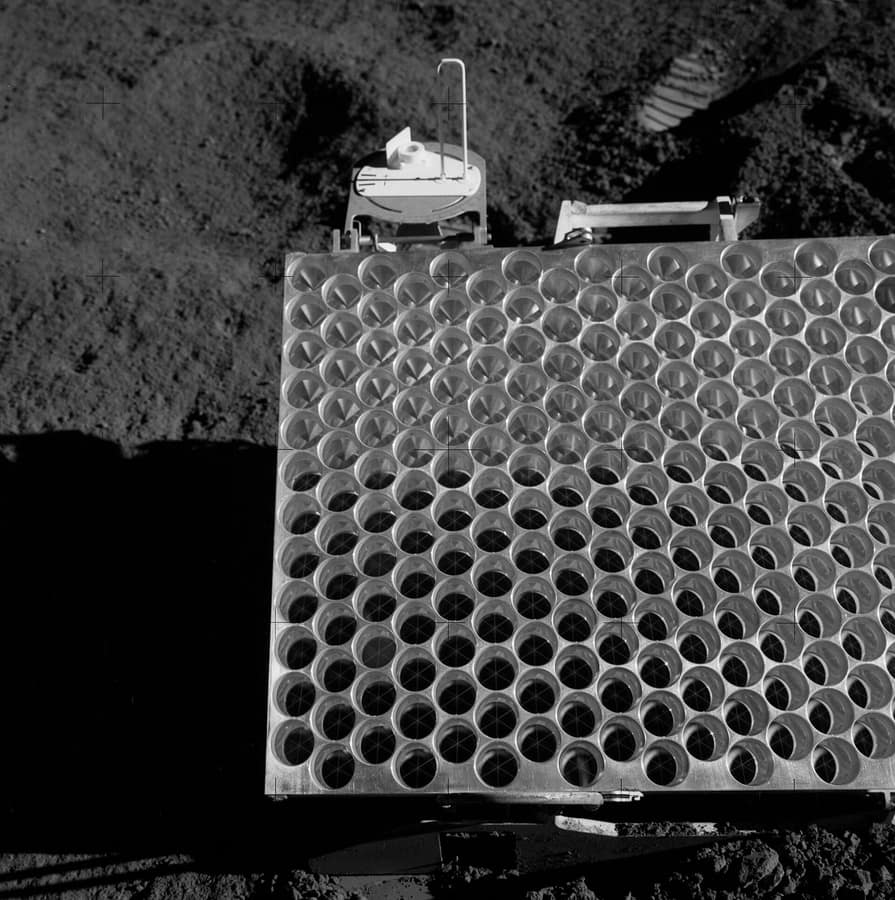
The Apollo 15 retroreflector. Lasers still bounce off it to measure the Moon drifting away. Photo: Dave Scott, NASA Jupiter's moon Io is the most volcanically active world in the solar system, with hundreds of erupting vents driven by the tidal squeezing of Jupiter's gravity. Voyager 1 caught the first plume in 1979, the first volcanic eruption ever seen off Earth.
Source: NASA
Beneath the cracked ice shell of Europa lies a salty ocean that may contain more liquid water than every ocean on Earth put together. The moon itself is slightly smaller than our own.
Source: NASA
Ganymede is the largest moon in the solar system at 5,268 kilometres across, comfortably bigger than the planet Mercury. It is also the only moon known to generate its own magnetic field.
Source: NASA
Titan is the only moon with a thick atmosphere, and the only world besides Earth known to have standing liquid on its surface: lakes and seas of methane and ethane. The Huygens probe landed there on 14 January 2005, the most distant landing ever made.
Source: European Space Agency
Saturn's small moon Enceladus fires jets of water vapour and ice grains out of fractures near its south pole. The Cassini spacecraft flew directly through those plumes and tasted the ocean below without ever landing.
Source: NASA
Triton orbits Neptune backwards, the only large moon in the solar system to travel against its planet's spin. That is the signature of a captured object, most likely a dwarf planet dragged in from the Kuiper Belt.
Source: NASA
Phobos circles Mars in about seven and a half hours, faster than Mars itself rotates, so from the surface it rises in the west and sets in the east. It is also spiralling inward and will eventually break apart.
Source: NASA
Halley's Comet returns roughly every 76 years and was last at perihelion in 1986, when a fleet of spacecraft including Europe's Giotto flew past its nucleus. Its next appearance is due in 2061.
Source: European Space Agency
On 12 November 2014 the Philae lander touched down on Comet 67P/Churyumov-Gerasimenko, the first soft landing on a comet. It bounced twice before settling in shadow, which cut its working life to about 60 hours.
Source: European Space Agency
Everything in the asteroid belt added together weighs less than five percent of the Moon. The objects are also spread so thinly that spacecraft have crossed the belt repeatedly without ever needing to dodge one.
Source: NASA
NASA's OSIRIS-REx capsule parachuted into the Utah desert on 24 September 2023 carrying roughly 120 grams of rock and dust from the asteroid Bennu. It was the largest asteroid sample ever returned to Earth.
Source: NASA
The Oort Cloud is a shell of icy bodies thought to surround the solar system at distances of thousands of astronomical units. Voyager 1, moving at around 17 kilometres per second, would need something like 300 years just to reach its inner edge.
Source: NASA
Betelgeuse, the red shoulder of Orion, faded dramatically through late 2019 and early 2020 in what astronomers called the Great Dimming. The cause was not an imminent explosion but a cloud of dust the star had ejected itself.
Source: European Southern Observatory
The nearest star to the Sun is Proxima Centauri, a red dwarf 4.24 light years away. It is far too faint to see without a telescope, despite being the closest star there is.
Source: European Southern Observatory
Sirius, the brightest star in the night sky, is a double act. Its companion Sirius B is a white dwarf packing roughly the mass of the Sun into a ball about the size of Earth.
Source: NASA
The first pulsar was picked up in 1967 by Jocelyn Bell Burnell, a graduate student who noticed a signal repeating every 1.34 seconds. It was labelled LGM-1 for Little Green Men until a second one turned up elsewhere in the sky.
Source: Royal Astronomical Society
The Sun is travelling around the centre of the Milky Way at roughly 230 kilometres per second, and still needs about 230 million years to complete one lap. The last time it was in this part of the galaxy, dinosaurs had barely started.
Source: NASA
The Andromeda Galaxy sits about 2.5 million light years away and is approaching us at around 110 kilometres per second. On a dark night it is visible to the unaided eye, making it the most distant thing most people will ever see without help.
Source: NASA
The first direct image of a black hole was released on 10 April 2019 by the Event Horizon Telescope. The target, M87*, is about 6.5 billion times the mass of the Sun and sits 55 million light years away.
Source: Event Horizon Telescope Collaboration
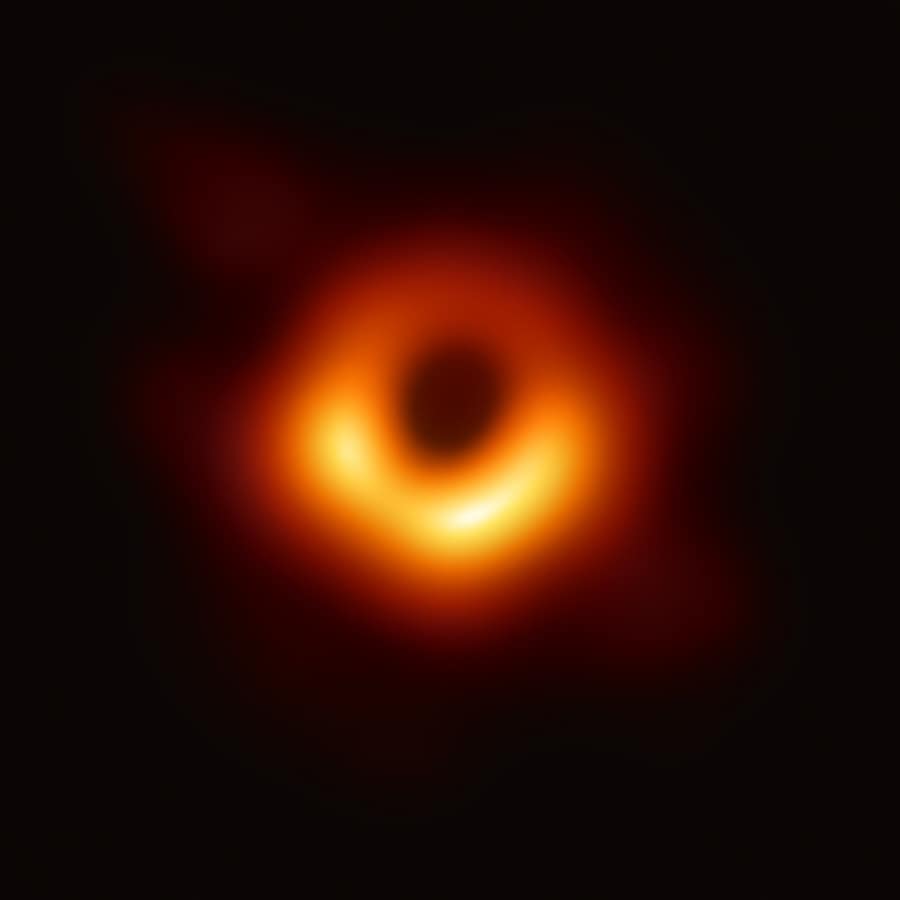
M87*, the first black hole ever imaged, released on 10 April 2019. Photo: Event Horizon Telescope, uploader cropped and converted TIF to JPG At the centre of our own galaxy sits Sagittarius A*, a black hole of roughly four million solar masses about 27,000 light years away. Decades of tracking stars whipping around it earned a share of the 2020 Nobel Prize in Physics.
Source: European Southern Observatory
The whole sky glows faintly at 2.725 degrees above absolute zero, the cooled afterglow of the early universe. Arno Penzias and Robert Wilson found it in the mid-1960s while trying to work out what was wrong with their antenna.
Source: NASA
Voyager 1 launched on 5 September 1977 and crossed into interstellar space in August 2012, the first human object to leave the Sun's bubble of influence. It carries a gold-plated record of sounds and images from Earth.
Source: NASA
Sputnik 1, launched on 4 October 1957, was a polished metal sphere 58 centimetres across that did nothing but beep. It transmitted for three weeks, and amateur radio operators worldwide could tune in.
Yuri Gagarin became the first human in space on 12 April 1961, completing a single orbit aboard Vostok 1 in 108 minutes. He ejected from the capsule and came down by parachute, which was always the plan.
Valentina Tereshkova flew Vostok 6 in June 1963, spending almost three days alone in orbit and circling Earth 48 times. That is more flight time than all the American Mercury astronauts combined, and nineteen years passed before another woman went to space.
Twelve people have walked on the Moon, all of them between July 1969 and December 1972. Nobody has been back since Apollo 17 lifted off from the Taurus-Littrow valley.
Source: NASA
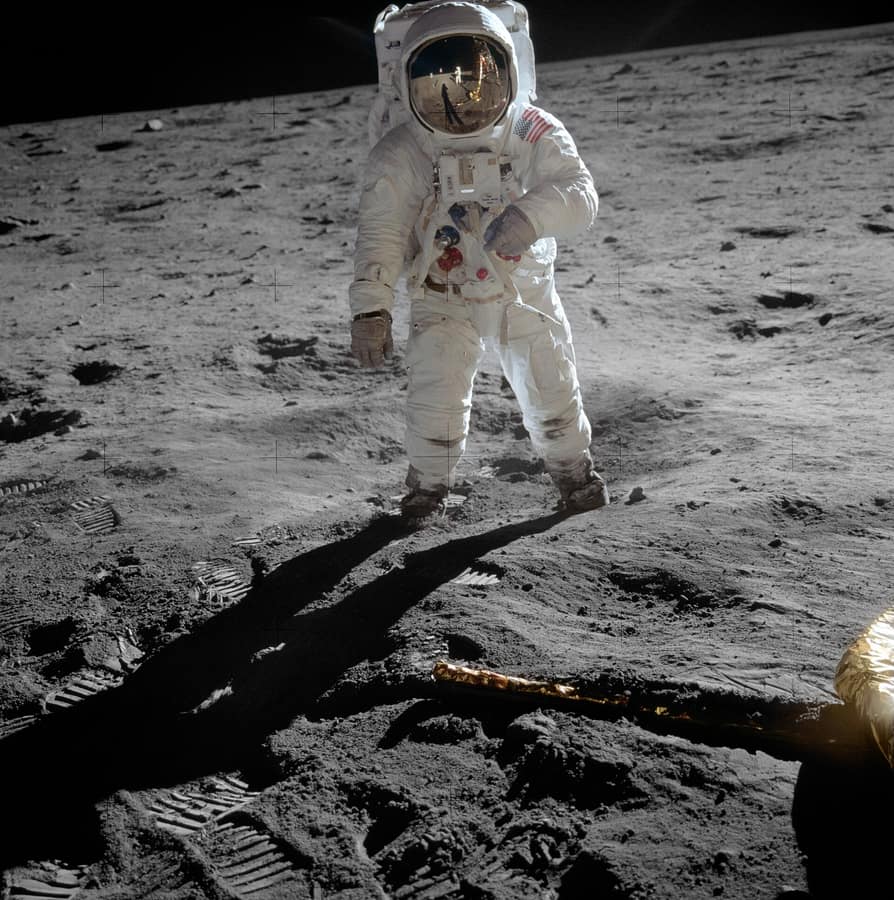
Buzz Aldrin on the Moon, July 1969. Only twelve people have made the walk. Photo: Neil Armstrong The International Space Station has had people living aboard continuously since 2 November 2000. Circling Earth roughly every 90 minutes, its crew sees about sixteen sunrises and sixteen sunsets a day.
Source: NASA