Fun Facts About the Human Body
You have been operating one of these your whole life without a manual. Forty facts about the bones, the bacteria and the several litres of blood currently doing their rounds.
A newborn arrives with roughly 300 bones, while a typical adult skeleton has about 206. The difference is not loss but fusion: separate pieces of cartilage and bone knit together as the body matures, most obviously in the skull and the sacrum.
Source: National Institutes of Health
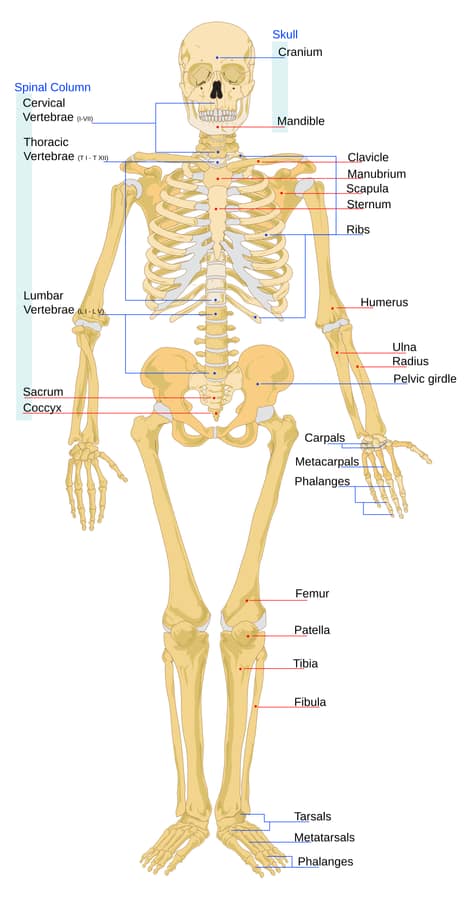
The adult skeleton settles at about 206 bones, down from roughly 300 at birth. Photo: LadyofHats Mariana Ruiz Villarreal More than half the bones in the human body are in the hands and feet. Each hand and wrist accounts for 27 and each foot and ankle for 26, which is 106 of the adult total of roughly 206.
The stapes in the middle ear is the smallest bone in the body, at around three millimetres long. It transmits vibration from the eardrum to the fluid of the inner ear, and it is fully grown at birth.
Source: Encyclopaedia Britannica
The femur is the longest and heaviest bone in the body, typically about a quarter of a person's height. It also carries the largest loads, routinely handling several times body weight during running.
Bone is not inert scaffolding. Adults replace roughly ten percent of their skeleton each year through remodelling, with osteoclasts dissolving old bone and osteoblasts laying down new material.
Source: National Institutes of Health
The gluteus maximus is the largest muscle in the body by mass, and it is unusually well developed in humans compared with other primates. Anatomists link its size to the mechanics of upright running.
Source: Nature
The masseter, the jaw muscle running from cheekbone to lower jaw, is among the strongest muscles relative to its size. Recorded human bite forces at the molars run into the hundreds of newtons.
Skeletal muscle contains a mix of slow-twitch fibres, which resist fatigue, and fast-twitch fibres, which contract quickly but tire fast. The proportions vary between individuals and between muscles in the same person.
Source: Cleveland Clinic
Shivering is muscle work repurposed as a heater. Rapid involuntary contractions produce almost no useful movement, so nearly all the energy comes out as heat.
A resting adult heart beats roughly 60 to 100 times a minute and pumps about five litres of blood in that time, which is close to the body's entire blood volume. Under hard exercise that output can rise several times over.
Source: American Heart Association
The heart has its own dedicated blood supply, the coronary arteries, because the blood rushing through its chambers cannot nourish the muscle walls directly.
Source: Cleveland Clinic
A red blood cell survives about 120 days in circulation, then is broken down mainly in the spleen and liver. Mature red cells carry no nucleus, which leaves more room for haemoglobin and gives them their flexible biconcave shape.
Source: National Institutes of Health
Blood is roughly 55 percent plasma by volume, and plasma is about 90 percent water. The straw colour of plasma is the actual colour of blood minus its cells.
Source: American Red Cross
The two lungs are not mirror images. The right lung has three lobes and the left has two, because the left one gives up space to the heart in a notch called the cardiac impression.
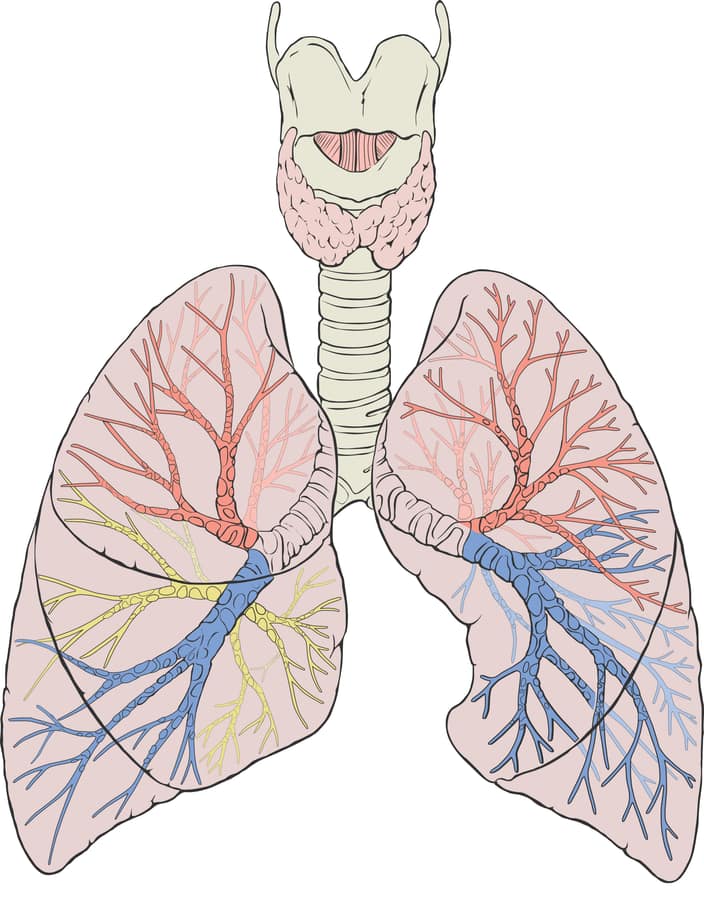
Three lobes on the right, two on the left. The heart takes the missing space. Photo: Patrick J. Lynch, medical illustrator Human lungs contain on the order of 300 to 500 million alveoli, the tiny sacs where gas exchange happens. Spread flat, that gas-exchange surface covers something close to the area of a tennis court.
Source: National Institutes of Health
Breathing out is usually the lazy half of the cycle. At rest the diaphragm and rib muscles do the work of inhaling, and exhalation happens largely by elastic recoil of the lungs and chest wall.
A yawn is one of the few reliably contagious behaviours in humans, and simply reading about yawning can trigger one. The physiological purpose of yawning itself remains unsettled.
The adult brain accounts for roughly two percent of body weight but consumes around twenty percent of the body's energy at rest. It is the most metabolically expensive organ per gram in ordinary daily life.
Source: National Institutes of Health
Current estimates put the number of neurons in the adult human brain at about 86 billion, alongside a comparable number of non-neuronal glial cells. The older textbook figure of 100 billion was an estimate that never had a careful count behind it.
Source: Journal of Comparative Neurology
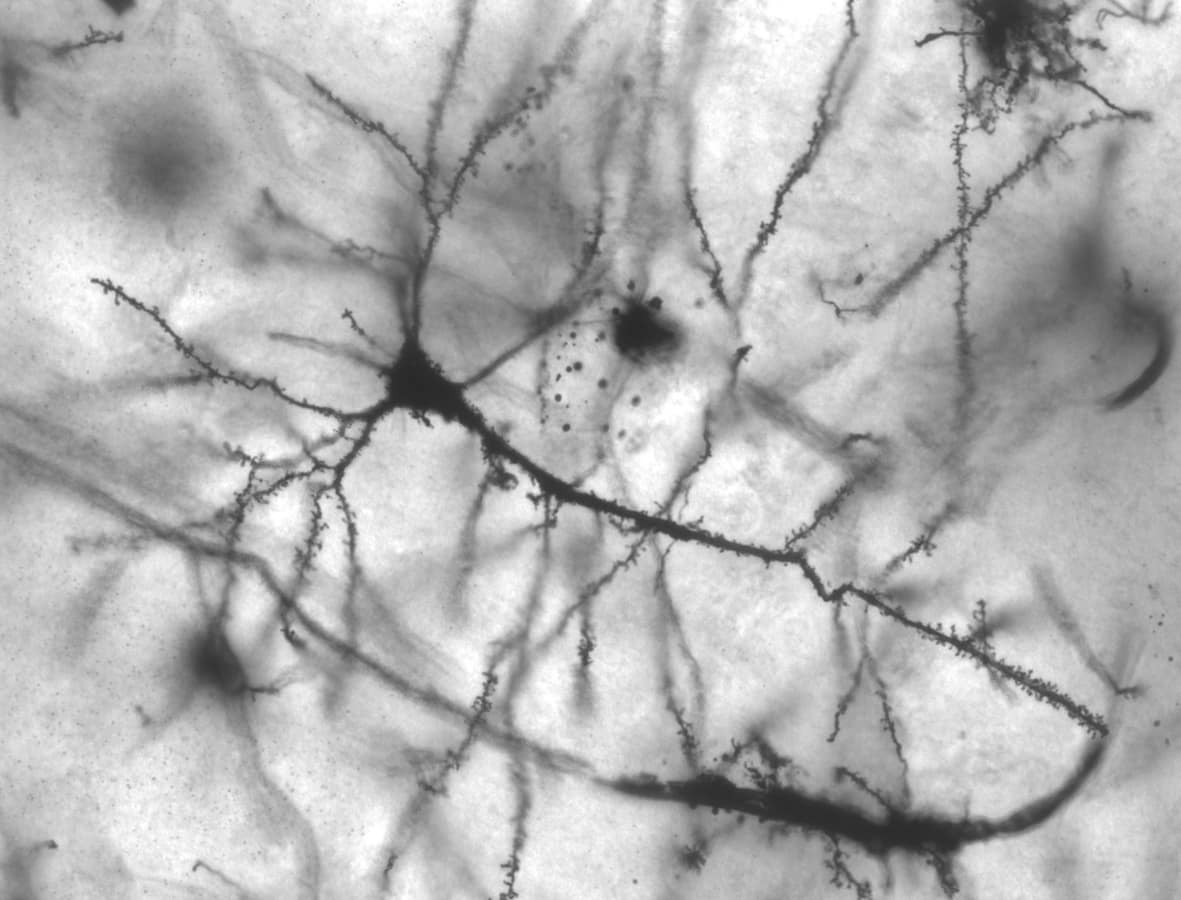
A pyramidal neuron of the hippocampus, one branching example among some 86 billion. Photo: MethoxyRoxy Nerve signals travel at very different speeds depending on the fibre. Thick myelinated motor fibres can conduct at well over 50 metres per second, while thin unmyelinated fibres carrying dull aching pain crawl along at around one metre per second.
Source: Cleveland Clinic
Brain tissue itself has no pain receptors, which is why neurosurgery can be performed on an awake patient. Headaches come from surrounding structures such as blood vessels, membranes and muscles.
Source: Johns Hopkins Medicine
The gut has its own nervous system, the enteric nervous system, containing hundreds of millions of neurons embedded in the wall of the digestive tract. It can coordinate digestion largely on its own.
Source: National Institutes of Health
Skin is the body's largest organ, covering roughly 1.5 to 2 square metres in an adult and accounting for about 15 percent of body weight. Its thickness ranges from well under a millimetre on the eyelids to several millimetres on the soles.
Source: Cleveland Clinic
The outer layer of skin is continuously replaced, with cells taking roughly a month to travel from the base of the epidermis to the surface and flake away. A large share of household dust is shed human skin.
Source: American Academy of Dermatology
Fingerprints form in the womb, driven partly by genetics and partly by the chance conditions of fetal development. Identical twins share DNA but not fingerprint patterns.
Source: National Institute of Justice

Ridge patterns form in the womb, which is why identical twins do not share them. Photo: The Photographersehh Goosebumps are a leftover reflex. A tiny arrector pili muscle at the base of each hair contracts and lifts it, which would fluff up an insulating coat in a furrier animal and does very little for us.
The cornea has no blood vessels, since vessels would scatter light and blur vision. It takes oxygen directly from the air and nutrients from tears and the fluid behind it.
Source: National Eye Institute
Each eye has a blind spot where the optic nerve leaves the retina and there are no photoreceptors. The brain fills the gap so seamlessly that most people never notice it without a deliberate test.
Source: National Eye Institute
The inner ear does double duty. Alongside the cochlea for hearing sit the semicircular canals and otolith organs, which sense rotation and acceleration and supply much of your sense of balance.
Source: National Institutes of Health
Healthy young humans hear roughly from 20 to 20,000 hertz, and the upper limit falls steadily with age. Sensitivity is sharpest in the range that carries speech.
Source: National Institute on Deafness and Other Communication Disorders
Adults have about 10,000 taste buds, and every bud can detect all the basic tastes rather than specialising by region of the tongue. Taste buds are also found on the palate and in the throat.
Source: National Institutes of Health
Much of what people call flavour is actually smell. Odour molecules reach the nose from the back of the mouth while chewing, which is why food tastes flat when nasal congestion blocks that route.
Source: Monell Chemical Senses Center
The small intestine is around six to seven metres long in a living adult and is where most nutrient absorption occurs. Folds, finger-like villi and microscopic microvilli multiply its absorbing surface enormously.
Source: National Institutes of Health
Stomach acid is strongly acidic, typically around pH 1.5 to 3.5, and the stomach survives it by secreting a thick mucus layer with bicarbonate underneath. The lining cells are also replaced rapidly.
Source: National Institutes of Health
The liver performs hundreds of distinct jobs, from filtering blood and processing nutrients to making bile and clotting proteins. It is also the only major internal human organ capable of substantial regeneration after part of it is removed.
Source: Mayo Clinic
The immune system keeps records. After an infection, memory B and T cells persist for years or decades, which is why a second encounter with the same pathogen is usually met far faster than the first.
Source: National Institutes of Health
Fever is not the infection but the response. The hypothalamus raises the body's temperature set point in reaction to immune signalling, and the chills people feel are the body working to reach the new target.
Source: Cleveland Clinic
A typical adult carries roughly as many bacterial cells as human cells, at a ratio near one to one rather than the ten to one figure long repeated. Most of them live in the large intestine.
Source: PLOS Biology
Any two unrelated humans are about 99.9 percent identical in their DNA sequence. The remaining fraction, spread over roughly three billion base pairs, still amounts to millions of individual differences.
Source: National Human Genome Research Institute
Mitochondrial DNA is inherited essentially from the mother alone, a separate small genome of about 16,500 base pairs sitting outside the cell nucleus. Genealogists use it to trace maternal lines across many generations.
Source: National Human Genome Research Institute